Author

Weathering the Storm: Not-for-Profit Hospitals Four Years Post-COVID
It has been four years since the World Health Organization declared COVID-19 a pandemic and the world shut down. The spring of 2020 was a period of incredible uncertainty for hospitals across the United States as they scrambled to adapt to new protocols and immense operating and financial pressures while treating the first of many waves of COVID patients. It was the start of a turbulent period for nonprofit hospitals, and while the sector is more stable today, we think some providers have emerged in a much stronger position than others. Read on for the lessons we’ve learned from the previous four years.
2020-2023: Staying afloat
In the early weeks of the pandemic, hospitals across the country faced a simultaneous decline in income and a surge in expenses. The sudden and seismic drop in financial markets also disrupted non-operating income at a time when hospitals were most in need. In late March 2020, the Coronavirus Aid, Relief, and Economic Security (CARES) Act passed, allocating $175 billion in relief funds to healthcare providers. These stimulus payments were critical to hospitals in the early months of the pandemic. While these relief funds did not always fully offset pandemic-driven losses, they provided a crucial lifeline through a challenging period. Many hospitals also benefited from a rapid rebound and subsequent boom in investment markets. As hospitals found some stability in late 2020 and early 2021, many returned to the debt market. Interest rates were highly attractive at the time, and some providers resumed capital projects they had delayed at the onset of the pandemic.
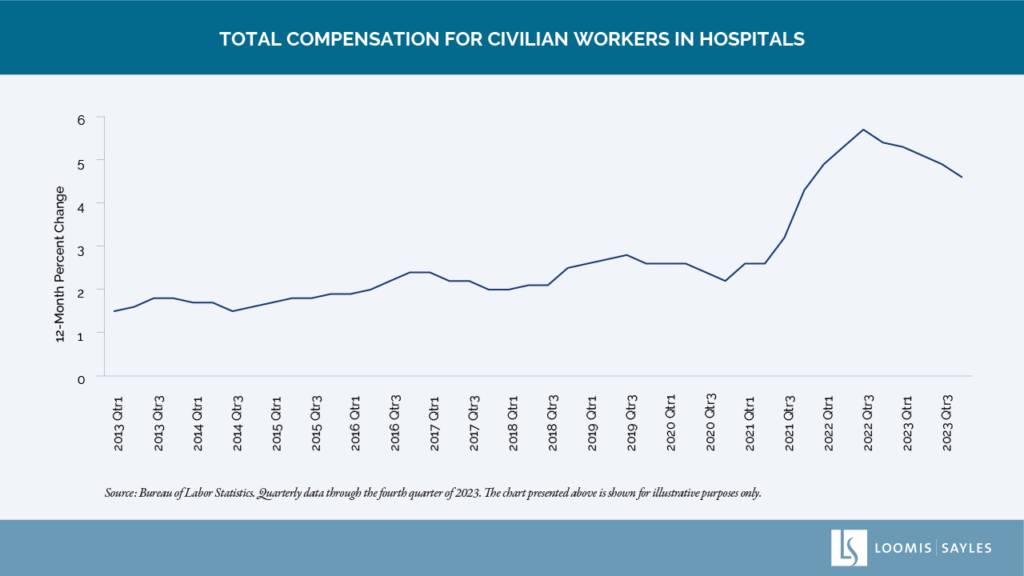
2021 and 2022 seemed to signal a turnaround for the hospital sector. However, as federal funds began to wane, hospitals faced a new crisis: an acute labor shortage. As the labor market tightened, hospitals faced significant competition for essential staff. The pandemic also exacerbated the national nursing shortage. Staffing challenges forced hospitals to raise salaries and wages, improve benefits and often use high-cost temporary labor and travelling nurses to avoid disruption in their services.
Present day: conditions remain challenging
In late 2023 and early 2024, hospital workforces began to stabilize, with wage growth slowing and job openings declining. Still, almost all providers are now operating with a significantly higher expense base given increases in salaries, benefits and wages. Sector-wide, operating margins, cash flow and liquidity remain below pre-COVID levels. While the healthcare sector is stabilizing overall, many providers have not yet turned the corner following the stress of the last several years, and some may not. Hospital closures and bankruptcies have generally been limited to speculative-grade and unrated providers, but even larger and historically more stable organizations have been forced to cut services, divest assets or consider acquisition.
Lessons learned from the turmoil
What lessons have we learned over the last four years? What do we think investors should look for as they consider long-term hospital credit quality?
- Bigger is better: health systems have benefited significantly from a broad revenue base, including multiple hospitals (particularly with geographic dispersion across different markets) and non-clinical sources of revenue, such as health plans or pharmacy businesses. This diversity can help offer a material offset if a single hospital, market or business line faces a period of financial distress.
- Location, location, location: hospitals in high-growth states have been much quicker to bounce back from operational stress. These markets also benefit from a larger labor pool, and have seen some insulation from labor-related financial pressures. Conversely, hospitals in states on the west coast have struggled recently with stringent labor regulations and a high cost of living, necessitating expanding workforces and increasing wages and salaries.
- Meet the patients where they are: COVID accelerated a shift in care consumption from inpatient to outpatient settings. More than ever, patients are receiving high-complexity care in facilities outside of the hospital. Hospitals must offer care in lower-cost ambulatory settings, or they may risk this lucrative business being poached by non-traditional competitors.
- Money matters: providers with healthy balance sheets have a natural cushion that helps insulate against operating stress and generate investment returns that support debt service coverage when operating cash flow is thin. Unrestricted reserves also help enable hospitals to make critical infrastructure investments without accessing the capital market in a period of prohibitively high interest rates.
In our view, it is critical to understand how a hospital or health system is equipped to meet the challenges ahead, and whether it is positioned to do so successfully. In a dynamic and increasingly bifurcated industry, we believe credit selection is more important than ever. Among not-for-profit hospitals, we have a strong preference for high ‘A’ and ‘AA’-rated names and credits bearing some or all of the characteristics described above. We think going up in quality could likely help shield investors from ongoing risk in the industry.
MALR032688
Market conditions are extremely fluid and change frequently.
This blog post is provided for informational purposes only and should not be construed as investment advice. Any opinions or forecasts contained herein reflect the subjective judgments and assumptions of the authors only and do not necessarily reflect the views of Loomis, Sayles & Company, L.P. Information, including that obtained from outside sources, is believed to be correct, but Loomis Sayles cannot guarantee its accuracy. This material cannot be copied, reproduced or redistributed without authorization. This information is subject to change at any time without notice.
Meet the Author